
Your employment agreement before day one

Before your next hire joins, the employment agreement must include four specific elements related to probation.
Duration: State the probation period clearly, typically three to six months. Without a defined end date, the period has no legal boundary and can be challenged.
Performance review process: Reference how performance will be assessed during probation. This does not need to be elaborate, but it must exist in writing within the agreement.
Termination clause: State the grounds and notice requirements for termination during probation. This single clause is what gives you legal protection when things do not work out.
Extension terms: If you need more time to evaluate, the agreement must permit a written extension. A verbal extension at a review meeting carries no legal weight.
For a closer look at what employment agreements commonly leave out, employment agreement essentials is a useful reference point.
Key fact: Under the OSH & Working Conditions Code, 2020, all employers must issue a formal appointment letter to every employee before or on their date of joining. This letter must include the probation period, applicable notice requirements, and terms of employment.
“Founders often assume the offer letter and the employment agreement are the same document. The offer letter is an invitation. The employment agreement is the legal contract that protects both parties.” — HR Legal Experts, audit observation
How to document the probation period
Three things must exist in writing during a probation period to make any termination defensible.
A written acknowledgement from the employee confirming receipt of the employment agreement, including the probation clause. At least one written performance check-in during the period, even a short email flagging concerns is sufficient to establish a record. A written confirmation of completion when the employee is retained, or a written extension notice served before the original period expires.
None of these require a formal HR department. They require a paper trail.
Key fact: Under the Industrial Relations Code, 2020, employers must follow a documented process before terminating employment. For probationary employees, the absence of written performance records significantly weakens the employer’s position in any resulting labour dispute.
“The companies that face the most difficulty in probation terminations are not the ones that made the wrong call about the employee. They are the ones that made the right call but had nothing on paper to show for it.” — HR Legal Experts, audit observation
Terminating during probation correctly
Probation does not give you the right to terminate without process. It gives you a shorter, simpler process, but that process must still be followed.
A valid termination during probation requires a written notice served to the employee, with the notice period specified in the employment agreement. Full and final settlement must be processed within two working days under the Code on Wages, 2019. A formal relieving letter must be issued regardless of how the relationship ended.
What it does not require is a detailed show cause notice or a disciplinary hearing, unless your employment agreement specifies otherwise. For structured exit documentation at each stage, employee exit process is a practical starting point.
Key fact: Under the Code on Wages, 2019, full and final settlement must be paid within two working days of the last working day for all terminations. Delays carry a penalty of up to ₹50,000 per instance under Section 51, regardless of whether the employee was on probation or confirmed.
“A probation termination that follows documented process takes two days. One that does not takes two months, a lawyer, and usually a settlement the company never planned for.” — HR Legal Experts, audit observation
Your employment agreements may already have gaps you are not aware of. The free HR compliance audit checks your documentation across 30 points in under 4 minutes and shows you exactly where your exposure is.
Start the audit: hrlegalexperts.com/free-hr-compliance-audit/
Common mistakes and their real cost
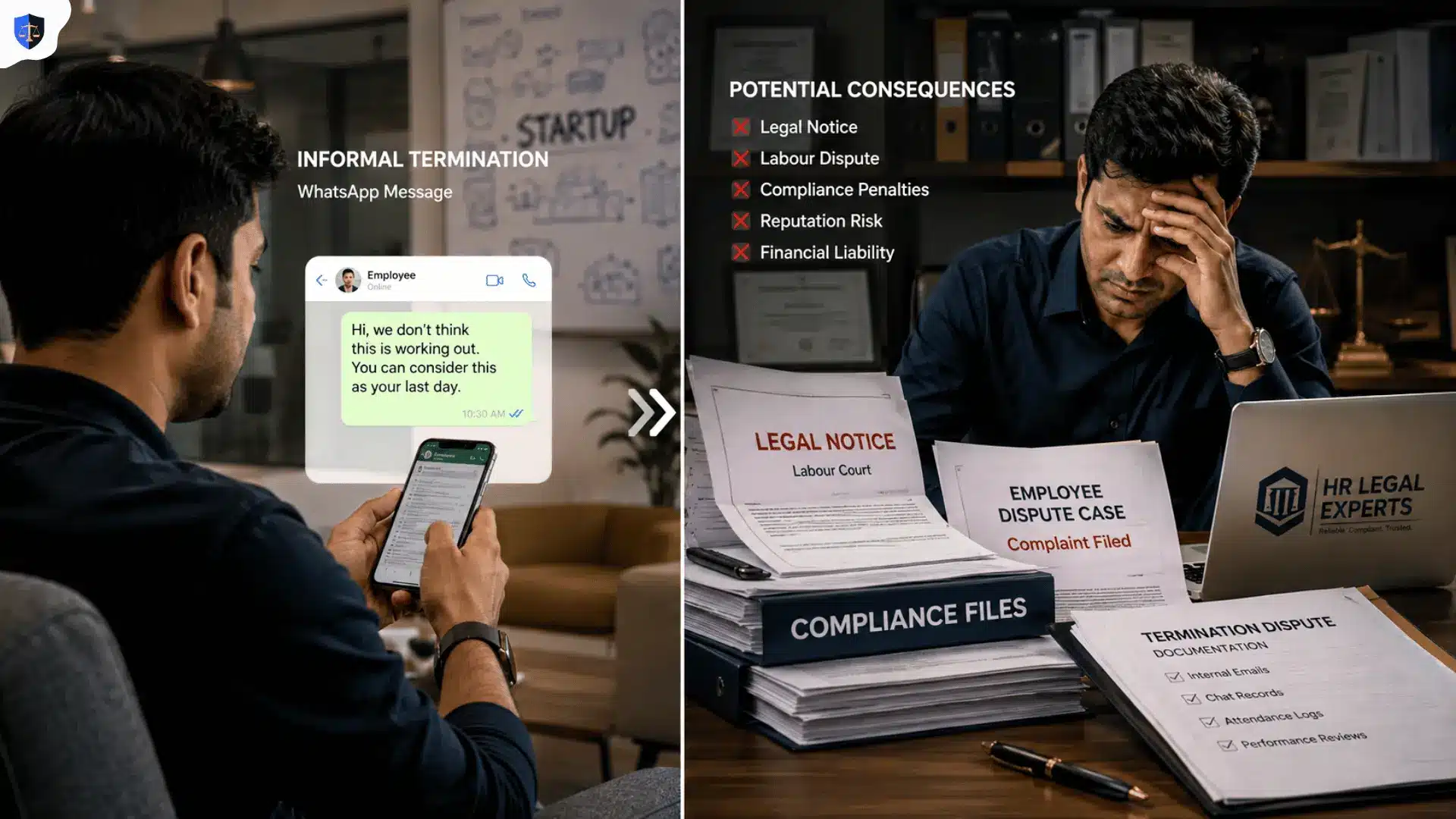
The same four mistakes appear across every probation dispute.
A founder sends a WhatsApp message instead of a written termination letter, assuming the employee understood it as a formal exit. Another founder extends probation verbally at a review meeting, not realising the original period legally ended that day and the employee is now considered confirmed. A third processes full and final settlement at month-end rather than within two working days, creating a separate penalty exposure under the Code on Wages, 2019.
The fourth and most common: no employment agreement was ever signed, so the probation clause that was supposed to protect the company never legally existed.
Each of these is avoidable with documentation that takes less than a day to prepare before hiring begins.
Key fact: Under the Industrial Relations Code, 2020, terminating an employee without following prescribed process carries a penalty of up to ₹50,000, regardless of whether the employee was on probation or confirmed at the time of termination.
“Every founder who has faced a probation dispute says the same thing afterwards: we thought it would be simpler because they were still on probation. Probation shortens the process. It does not remove it.” — HR Legal Experts, audit observation
Probation rules: quick reference
Probation clause Must be in a signed employment agreement before the employee joins.
Duration 3 to 6 months, defined in writing within the agreement.
Performance review Referenced in the agreement and conducted in writing during the period.
Termination notice Written notice, with the notice period specified in the employment agreement.
FnF settlement Within 2 working days of the last working day, as required under the Code on Wages, 2019.
Period extension Must be communicated in writing before the original probation period ends.
One missing clause in your employment agreement is the difference between a clean two-day exit and a two-month legal dispute. Check your documentation before your next hire joins.
Run the audit: hrlegalexperts.com/free-hr-compliance-audit/
Frequently Asked Questions
1) What is the maximum probation period allowed in India?
Indian law does not prescribe a maximum probation period. Under the Industrial Relations Code, 2020 and most state standing orders, three to six months is the accepted standard. A period beyond six months is permissible if the employment agreement explicitly allows it, but extended probation without a valid contractual basis can be challenged as a circumvention of employee rights.
2) Can an employer terminate without notice during probation in India?
Termination without notice during probation is not legally protected unless the employment agreement explicitly states this. Under the OSH & Working Conditions Code, 2020, all terminations must be accompanied by a formal written letter. Verbal terminations, WhatsApp messages, and informal communications carry the same legal risk as terminating a confirmed employee.
3) Does the probation period count towards gratuity in India?
Under the Social Security Code, 2020, the probation period counts towards total length of service for gratuity calculation, provided the employee is eventually confirmed. Gratuity becomes payable after five continuous years of service, and the probation period is included in that calculation from the date of joining.
4) What should a probation clause include in an employment agreement?
A valid probation clause must specify the duration of the probation period, the performance assessment criteria, the notice period applicable during probation, the grounds for termination, and the terms for extension if required. All of these elements must appear in the signed employment agreement before the employee joins.
5) Can a probation period be extended in India?
A probation period can be extended if the employment agreement permits it and the extension is communicated to the employee in writing before the original period ends. Under the Industrial Relations Code, 2020, an employee whose probation expires without a written extension or confirmation notice can legally argue their employment has been confirmed by default.
5) What happens if an employee resigns during probation in India?
An employee resigning during probation is bound by the notice period specified in the employment agreement for probationary employees. Under the Code on Wages, 2019, full and final settlement must be processed within two working days of the last working day, regardless of whether the separation was initiated by the employer or the employee.

HR Legal Experts is a specialized consulting firm helping businesses stay fully compliant with labour laws and HR policies. With a proven track record of serving 500+ organizations, we deliver customized solutions in POSH compliance, employee handbooks, contracts, and regulatory documentation. Our team combines legal expertise with practical HR insights to ensure risk-free, people-first workplaces.
