
Startup HR compliance India just became a legal obligation with real financial penalties.
India’s four new Labour Codes came into effect on 21 November 2025. If your startup has not reviewed its payroll, employment contracts, or leave policy, you are not behind on admin. You are exposed to fines, recovery notices, and employee complaints that can surface any time.
Most founders plan to sort this out later. That plan is exactly what turns a small compliance gap into an inspection notice you cannot quietly resolve.
Here is what changed, what it costs you to ignore it, and how to fix it without disrupting your team.
The short version
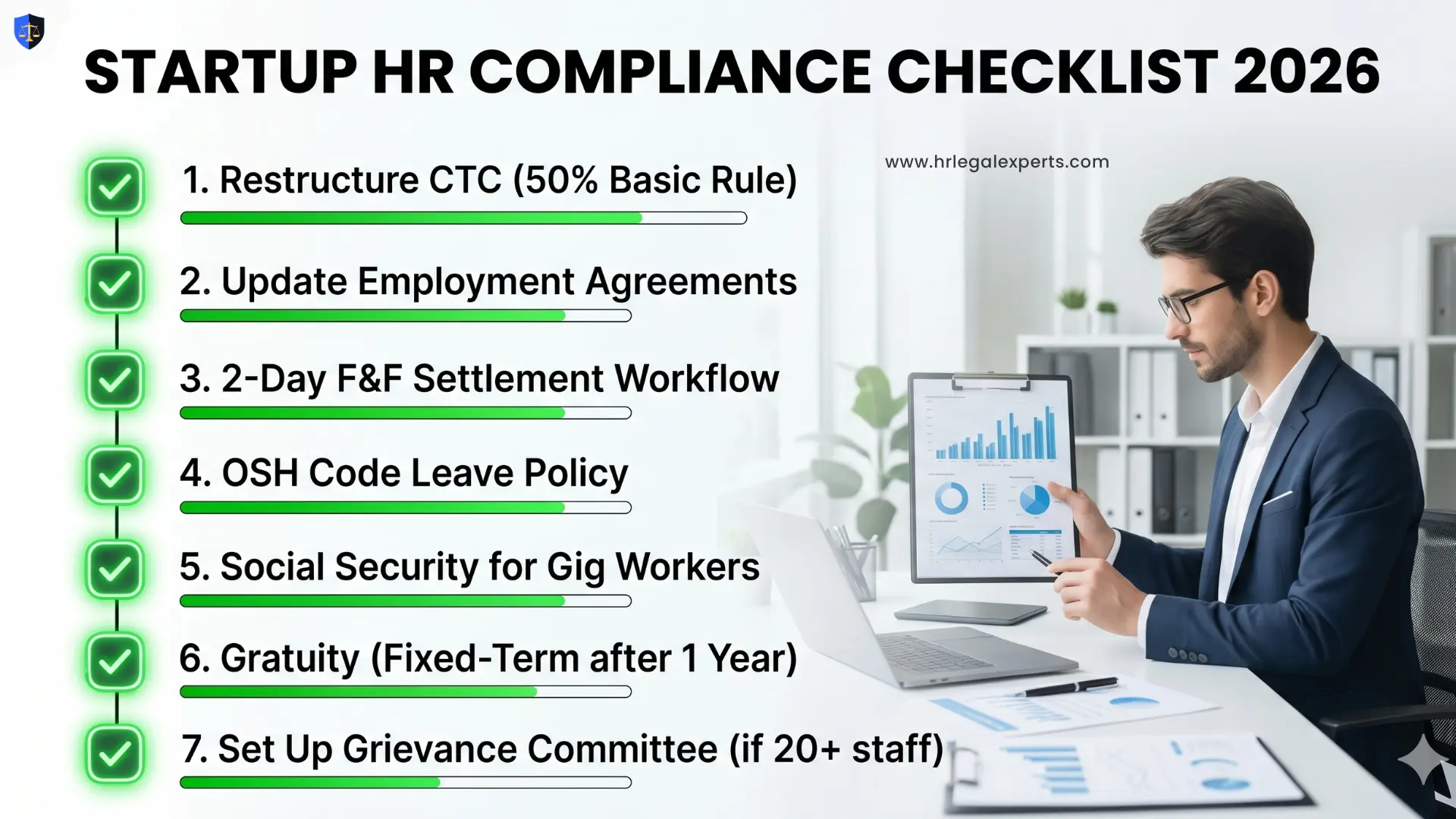
• Four Labour Codes replaced 29 central labour laws, effective 21 November 2025
• Basic salary must now be at least 50% of total CTC under the Code on Wages, 2019
• Full and Final Settlement must clear within 2 working days of an employee’s last day
• Fixed-term employees qualify for gratuity after 1 year, not 5
• Gig and platform workers now have statutory social security rights for the first time
What are the four new Labour Codes?
India had 29 separate labour laws. They were confusing, overlapping, and easy to misread. As of 21 November 2025, all 29 have been merged into four codes, confirmed by the Ministry of Labour and Employment’s official gazette notification.
• The Code on Wages, 2019: covers minimum wages, salary structure, and payment timelines for all establishments regardless of size
• The Industrial Relations Code, 2020: covers employment contracts, fixed-term hiring, trade unions, and exit processes
• The Code on Social Security, 2020: covers PF, ESI, gratuity, maternity benefits, and now includes gig workers for the first time
• The Occupational Safety, Health and Working Conditions Code, 2020: covers working hours, safety standards, and leave entitlements
For most startups, the Code on Wages, 2019 and the Social Security Code, 2020 need attention first. Get these wrong and the consequences are immediate.
Startup HR compliance India: five areas where you must act now
1. Payroll and CTC structure: the 50% wages rule
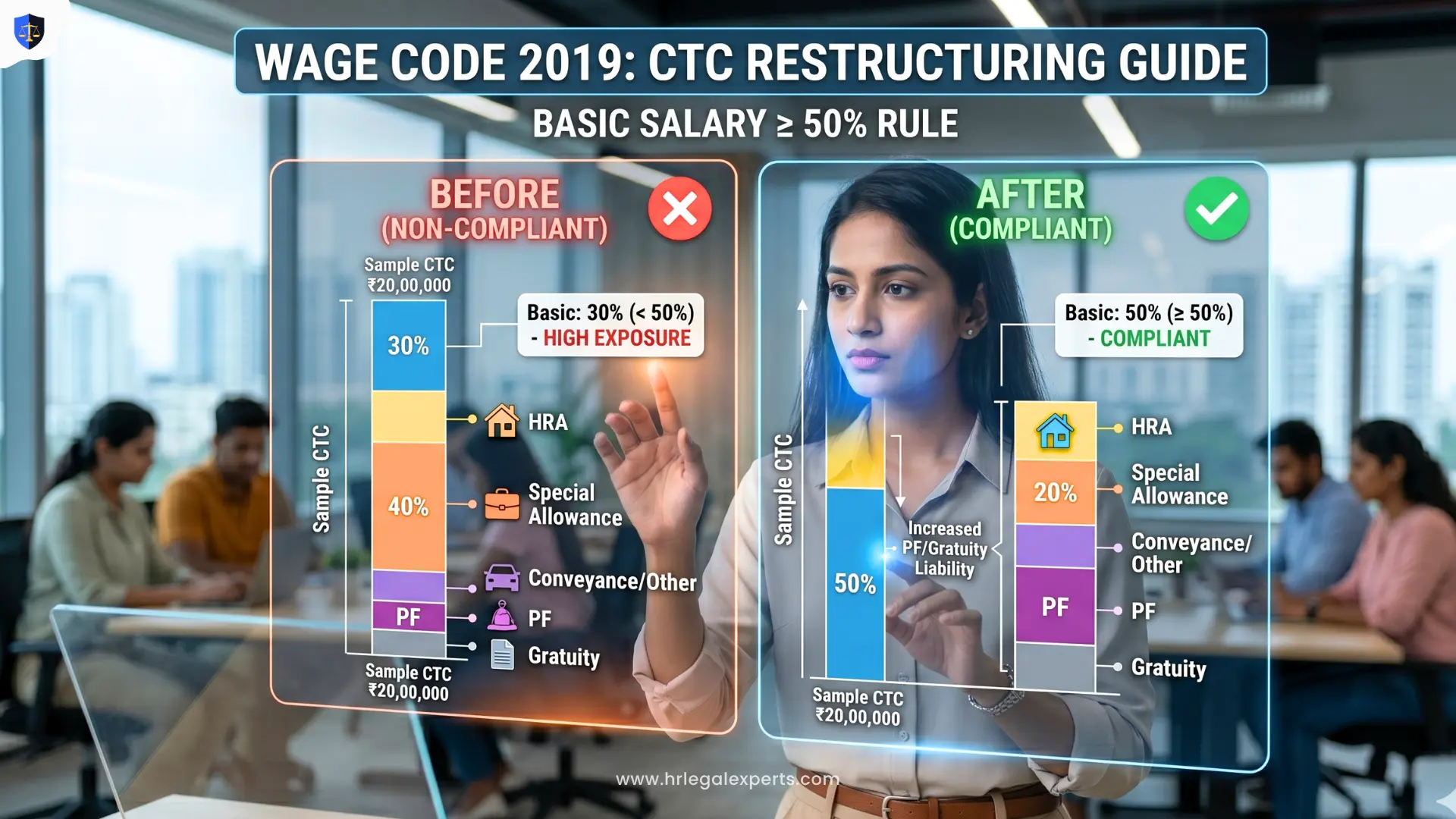
Many startups built salary structures with low basic pay and high allowances, HRA, conveyance, special allowances. It kept PF and gratuity costs down. That structure is now non-compliant.
Under the Code on Wages, 2019, basic salary must be at least 50% of total CTC. If allowances push basic below that threshold, the excess gets reclassified as wages, which means higher PF, higher gratuity, and potentially lower take-home for some employees with no change to gross CTC.
In practice, the breach almost always sits in the special allowance line, not HRA. That is the first place to audit.
Key fact: Under the Code on Wages, 2019, basic salary must be ≥ 50% of total CTC. Breaching this triggers reclassification of allowances as wages, directly increasing PF and gratuity liability.
Action required: Check every employee’s CTC. If basic salary is below 50% of total CTC, your payroll does not comply with the Code on Wages, 2019. Use our employment cost calculator → to model the impact before restructuring.
2. Full and final settlement: the 2-working-day rule
When an employee leaves, you now have two working days to clear their Full and Final Settlement. That is the entire window.
Under the old Payment of Wages Act, 1936, this timeline was vague enough that 30 to 45 days became standard. Under the Code on Wages, 2019, day three is already a violation, and the employee can file a formal complaint immediately under the new digitised grievance system.
In practice, most FnF delays we see are not a payroll problem, they are stuck at finance approval. That bottleneck needs to be fixed before your next exit, not after.
Key fact: Under the Code on Wages, 2019, FnF delayed beyond 2 working days is a statutory violation from day three, not a process gap. Any employee can escalate it as a formal complaint immediately.
3. Leave policy alignment under the OSH Code
If your leave policy was last updated under a state Shops and Establishments Act, it is almost certainly misaligned with the Occupational Safety, Health and Working Conditions Code, 2020.
Wrong leave calculations are the most commonly flagged issue in labour audits, and one of the easiest to fix before it becomes a problem.
Key fact: Leave entitlement errors under the OSH Code, 2020 are among the top three audit triggers for startups. A policy review takes hours. An audit response takes weeks.
For a detailed breakdown of what to update, see our leave policy guide for startups →
4. Gig workers and platform workers: new social security obligations
For the first time, gig and platform workers have statutory social security rights under the Code on Social Security, 2020. If your startup uses them, you may be required to contribute 1 to 2% of annual turnover to a dedicated Social Security Fund, capped at 5% of total payments made to such workers annually.
The old assumption, freelancers carry no statutory cost, no longer holds. If you have not assessed this, you have an unquantified liability in your books right now.
Key fact: Under the Code on Social Security, 2020, aggregators engaging gig or platform workers must contribute to a Social Security Fund. This applies regardless of whether workers are classified as employees.
5. Fixed-term employment: gratuity after one year
Under the old Payment of Gratuity Act, 1972, gratuity required five continuous years of service. Under the Industrial Relations Code, 2020, fixed-term employees qualify for proportionate gratuity after just one year.
If you use fixed-term contracts for project roles and have not updated your cost modelling, your employment cost projections are understated, and that gap compounds with every hire.
Key fact: Fixed-term employees are entitled to proportionate gratuity after 1 year of continuous service under the Industrial Relations Code, 2020. The previous 5-year threshold no longer applies to this category.
For legally updated fixed-term contract templates, see our employment agreement templates →
Most startups have three HR compliance gaps they do not know about. Find yours before a labour inspector does.
We conduct focused Labour Code compliance audits for startups across India and give you a clear, actionable fix.
Talk to our team today →
What happens if your startup is non-compliant?
Under the new codes, a single employee complaint filed online can trigger an inspection. You do not need to be a factory or have 500 employees. Enforcement is now digitised, randomised, and faster than anything under the old system.
Here is what non-compliance costs:
• Fines up to Rs 1 lakh for first offences under the Code on Wages, 2019, with imprisonment provisions for repeat violations
• PF and ESI recovery notices with 12% annual interest and damages up to 100% of dues owed
• Formal employee complaints escalated directly to the Grievance Redressal Committee, a new mandatory body under the Industrial Relations Code, 2020 for establishments with 20 or more workers
• Investor due diligence flags, startup HR compliance in India is now routinely checked in pre-funding reviews. Gaps here delay or derail rounds.
Getting compliant costs far less than getting caught.
Note on transition provisions: Final Central and State Rules are still being notified. The Central Government has indicated 1 April 2026 as the target for final rules. Existing rules remain in force where they do not conflict with the codes. Your startup HR compliance obligations in India are live now, not pending.
Source: DLA Piper — New Labour Codes Usher in a New Era of Compliance, January 2026
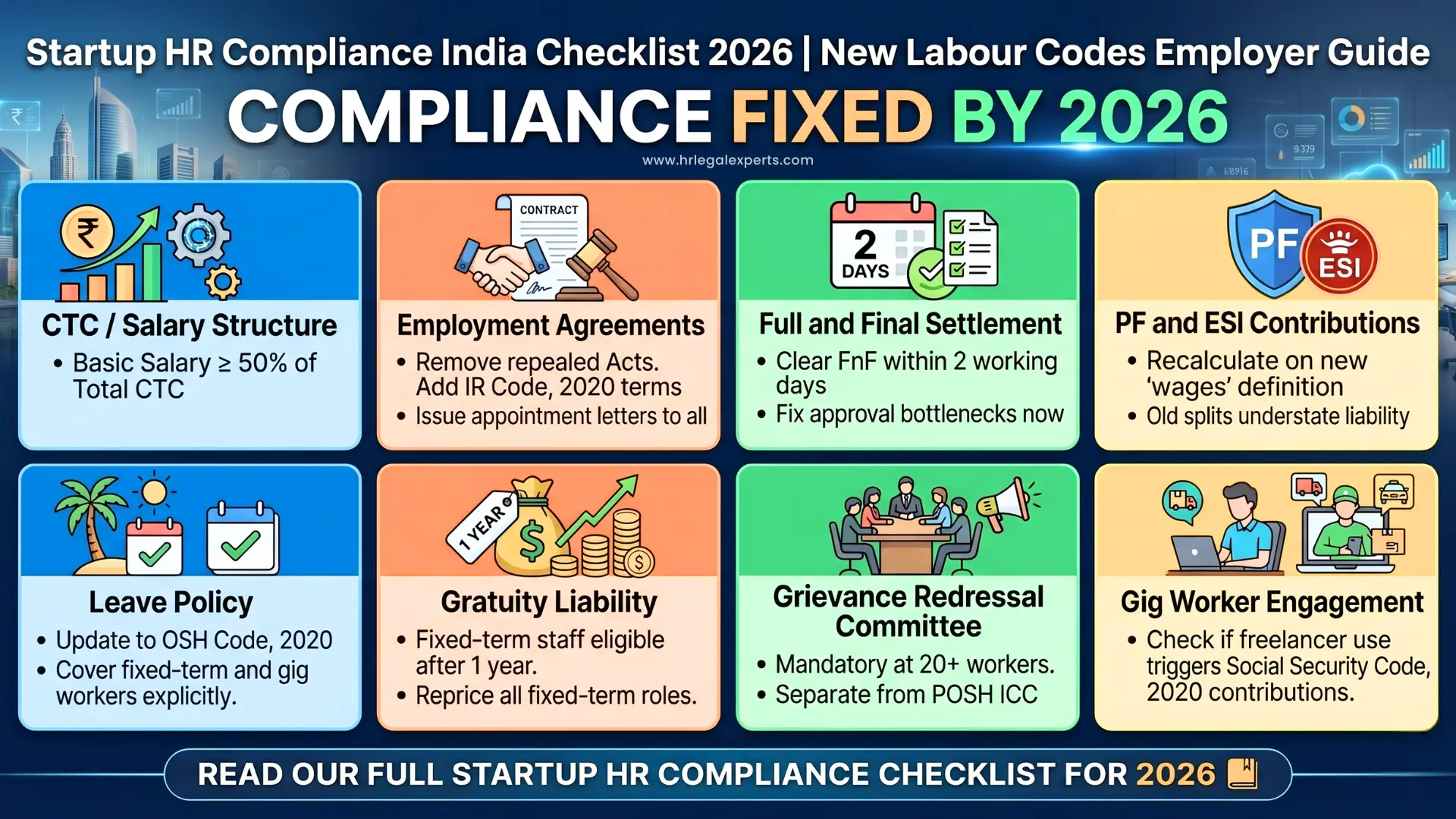
Startup HR compliance India: your 2026 checklist
|
Compliance area |
What to check |
|
CTC / salary structure |
Basic salary ≥ 50% of total CTC |
|
Employment agreements |
Remove repealed Acts. Add IR Code, 2020 terms. Issue appointment letters to all. |
|
Full and final settlement |
Clear FnF within 2 working days. Fix approval bottlenecks now. |
|
PF and ESI contributions |
Recalculate on new ‘wages’ definition. Old splits understate liability. |
|
Leave policy |
Update to OSH Code, 2020. Cover fixed-term and gig workers explicitly. |
|
Gratuity liability |
Fixed-term staff eligible after 1 year. Reprice all fixed-term roles. |
|
Grievance Redressal Committee |
Mandatory at 20+ workers. Separate from POSH ICC. |
|
Gig worker engagement |
Check if freelancer use triggers Social Security Code, 2020 contributions. |
Where most startups get their HR compliance wrong in India
After auditing organisations across India, these are the four failures we see most:
Using old contract templates that still reference the Payment of Wages Act, 1936 or the Industrial Disputes Act, 1947, both now subsumed into the new codes. Your contracts are citing laws that no longer exist.
Assuming size protects you, believing compliance only kicks in above a certain headcount. The Code on Wages, 2019 applies from your very first hire.
Wrong gratuity modelling for fixed-term staff, still calculating on a five-year threshold when the Industrial Relations Code, 2020 says one year. Every fixed-term hire made without updating this model is an unaccounted liability.
No structured FnF process, without a defined workflow, you cannot legally clear an exit in two working days. Every departure is already a potential violation.
If any of these apply, a legally compliant HR handbook built on current legislation is where you start. See our HR handbook guide for Indian startups →
How to get compliant without disrupting your team
You do not need to overhaul everything overnight. Here is the sequence that works for most startups:
1) Audit all CTCs against the Code on Wages, 2019 — flag anything where basic is below 50%
2) Update employment agreements — remove repealed Acts, add current code references
3) Fix your FnF approval workflow to meet the two-working-day requirement
4) Align your leave policy with the OSH Code, 2020 for your state
5) Assess all freelancer and platform engagements against the Social Security Code, 2020
6) Set up a Grievance Redressal Committee if you are at or approaching 20 workers
Start with contracts and CTC. These two documents drive the most compliance exposure for Indian startups at every growth stage.
For further reading on the broader reform, see SHRM India’s overview of the Labour Code changes and the International Labour Organization’s India briefing.
Get your startup HR-compliant before it costs you
HR Legal Experts works with startups across India to close compliance gaps before they become penalties, complaints, or due diligence red flags.
We review your CTC, contracts, leave policy, and FnF workflow. You get a clear, practical plan.
Fix your HR compliance now →

HR Legal Experts is a specialized consulting firm helping businesses stay fully compliant with labour laws and HR policies. With a proven track record of serving 500+ organizations, we deliver customized solutions in POSH compliance, employee handbooks, contracts, and regulatory documentation. Our team combines legal expertise with practical HR insights to ensure risk-free, people-first workplaces.
