A free HR policy audit is a 30-point diagnostic that maps your company’s HR practices against six Indian labour laws and shows your exact penalty exposure in rupees. It takes under 4 minutes.
The HR policy audit is the fastest way for a founder to know, in under 4 minutes, exactly how much legal exposure their company is carrying right now.
Most 0 to 50 employee companies in India assume they are broadly compliant. They are not. Across six labour codes and the POSH Act, the average early-stage company carries gaps in three or more sections, and the maximum penalty exposure across all checks runs to ₹16.7 lakh per inspection cycle.
India’s first AI-native HR compliance audit tool runs all 30 checks in under 4 minutes, calculates your exact penalty exposure in real time, and produces a written legal brief specific to your company.
This article explains what the audit covers, why founders consistently score low, how to complete it step by step, and what to do with your results.
Summary
Maximum penalty exposure: ₹16.7 lakh across 30 checks and six Indian labour laws.
In this article you will learn:
✦ What the free HR policy audit covers across six laws and 30 checks
✦ Why most founders score 0% on at least three sections
✦ How an AI audit differs from a PDF checklist
✦ Exactly how to complete the audit step by step
✦ How to read your results and act on them in the right order
No HR team required. You need 4 minutes and honest answers about what your company has formally in place.
What the HR policy audit covers
The audit runs 30 checks across six areas of Indian labour law. Each check maps to a specific law, carries a named penalty, and updates your total exposure in real time as you respond.
Code on Wages, 2019 Salary timelines, minimum wages, equal pay, overtime rates, and wage record formats. Five checks. Penalty range per gap: ₹30,000 to ₹90,000.
Social Security Code, 2020 PF and ESIC deductions, gratuity timelines, maternity provisions, and registration compliance. Five checks. Penalty range per gap: ₹50,000 to ₹1 lakh.
OSH & Working Conditions Code, 2020 Offer letters, working hours, safety infrastructure, and annual employee health checks. Five checks. Penalty range per gap: ₹20,000 to ₹1 lakh.
Industrial Relations Code, 2020 Termination process, standing orders, grievance mechanisms, and notice period compliance. Four checks. Penalty range per gap: ₹25,000 to ₹1 lakh.
POSH Act, 2013 ICC constitution, written policy, training records, annual filing, and external member appointment. Five checks. Penalty range per gap: ₹25,000 to ₹50,000.
Contract Labour & PF/ESIC Contract Labour Act registration, ECR filings, ESI challans, Form XIII and XIV registers, and principal employer certification. Five checks. Penalty range per gap: ₹50,000 to ₹1 lakh.
The Ministry of Labour publishes the full text of all four Labour Codes for reference.
Key fact: The Code on Wages, 2019 requires salary payment within 7 days of month-end for all covered establishments. Non-compliance under Section 51 carries a penalty of ₹50,000 per instance, rising to ₹1 lakh for repeat offences.
“Almost every company that fails the wage section believes it pays on time. The failure is in format: wage registers are on pre-2019 templates, and the minimum wage basis is calculated against the wrong state notification for the current year.” — HR Legal Experts
If you are not certain your wage registers are in the correct format, your audit result will tell you exactly where the gap is.
Why founders score zero initially
The pattern is consistent across every audit we run. Founders have done many of the right things, but none of them are documented in a legally sufficient format.
Consider what this looks like in practice:
|
What founders assume |
What audits reveal |
|
“We pay on time, so wages are compliant” |
Wage register format is outdated under the Code on Wages, 2019 |
|
“We deduct PF, so social security is covered” |
ECR register is not maintained in the correct format |
|
“We did POSH training once” |
No attendance record exists and annual filing was never done |
|
“We have an offer letter process” |
Letters are not standardised and missing mandatory clauses |
|
“We use contract workers through a vendor” |
Principal employer obligations under Contract Labour Act were never registered |
The audit does not weigh intent. It checks whether each requirement is formally in place, which is exactly what a labour department inspector checks.
The new Labour Codes, operationalised in late 2025, raised the documentation bar significantly. Practices that were informally acceptable before 2020 now require specific written formats and registrations to count as compliant.
Key fact: Under the Industrial Relations Code, 2020, all companies must maintain a formally documented grievance redressal mechanism. Non-compliance carries a penalty of ₹25,000, and the absence of written HR policies creates significant legal exposure during any employment dispute.
“The section founders are most surprised by is POSH. Not because their workplace is unsafe, but because the annual report required under Section 21 of the POSH Act, 2013 was never filed with the District Officer. The obligation exists on paper. The filing does not.” — HR Legal Experts
Your gaps are probably not where you think they are. The audit shows you exactly where they are.
Checklist vs. AI audit: what is the difference
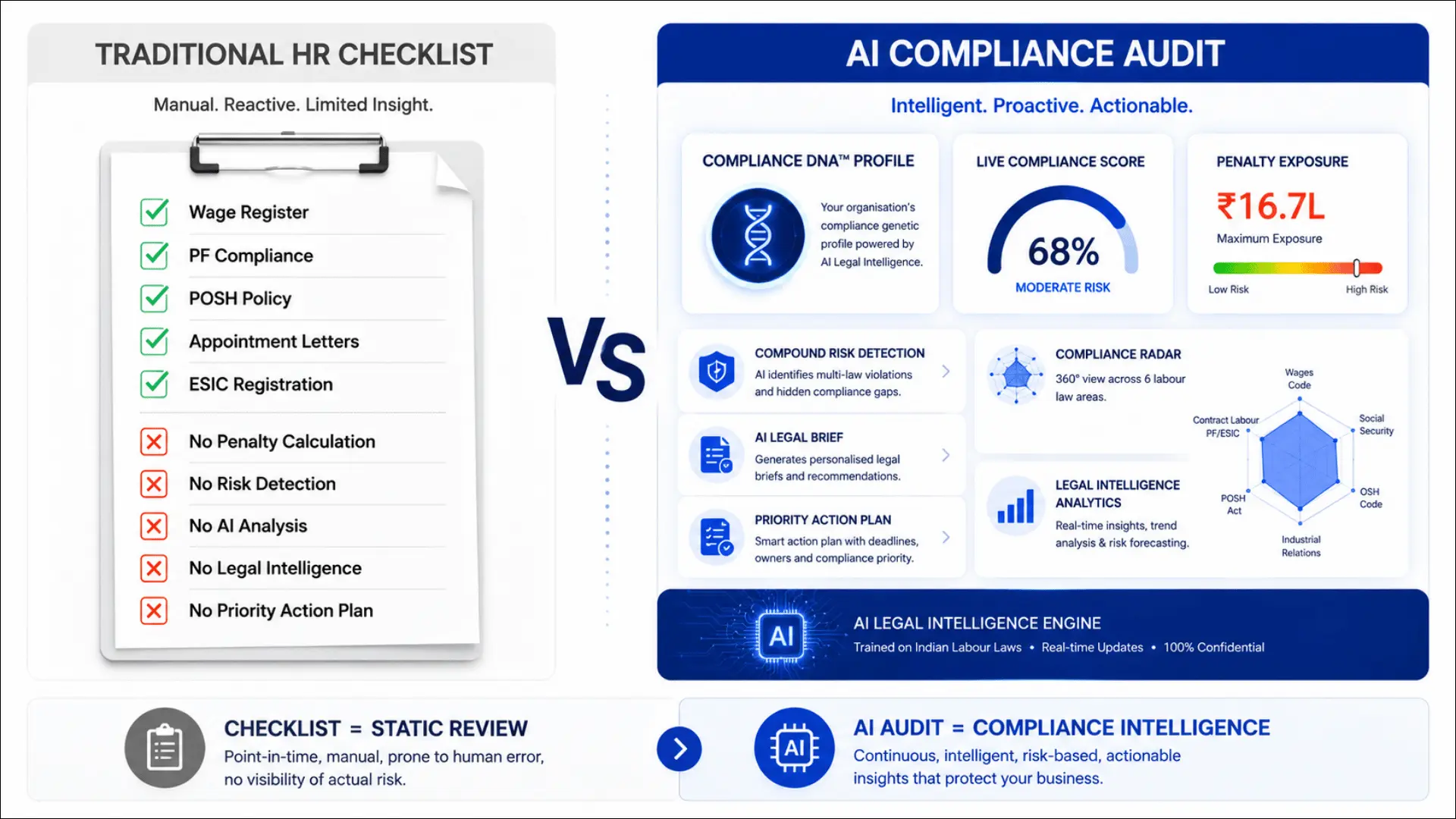
Most founders searching for a free HR policy audit find a PDF checklist first. A checklist tells you what to check. It does not tell you what each gap costs, which gaps interact to create compound risk, or what your total legal exposure looks like right now.
The audit tool at hrlegalexperts.com does three things a checklist cannot:
• Calculates your penalty exposure in real time, mapped to the exact law and penalty section
• Detects compound legal risks when two or more gaps interact to create elevated exposure
• Generates a Compliance DNA™ profile and written AI legal brief specific to your company’s identified gaps
A checklist is a starting point. This audit gives you the answer.
Key fact: Under the POSH Act, 2013, any organisation with 10 or more employees must constitute a formal Internal Complaints Committee under Section 4. Failure carries a penalty of ₹50,000 under Section 26, rising to ₹1 lakh and possible business licence cancellation for repeat non-compliance.
“Founders who complete a PDF checklist and feel reassured are usually the ones carrying the highest actual exposure. A checklist has no mechanism to tell you that two ticked boxes are still non-compliant because the underlying documents are in the wrong format.” — HR Legal Experts
How the free HR policy audit works
The entire process takes under 4 minutes. Here is exactly what happens.
Step 1: Open the tool Go to hrlegalexperts.com/free-hr-compliance-audit/. The page gives you a full overview of what the audit covers and how the AI analysis is generated.
Step 2: Fill in your company details Click “Begin Compliance Intelligence Audit.” Enter your name, company name, business email, mobile number, company size, and industry. This takes under 60 seconds and personalises the AI output to your specific company context.
Step 3: Work through the six sections Each section presents four to five checks. For every check, you confirm whether the practice is formally in place at your company. Three things update live as you respond:
• Your compliance percentage for that section
• The Penalty Exposure Meter, starting at ₹16.7 lakh and decreasing as you confirm compliant items
• A live compliance radar chart showing your risk profile across all six areas
Step 4: Generate your AI legal brief At the end of Section 6, click “Generate AI Legal Intelligence Report.” The tool produces a streaming Compliance DNA™ profile, compound risk analysis, and a written legal brief specific to your company’s identified gaps.
Step 5: Receive your results and act Your report shows which gaps carry the highest penalty risk. If your score is in the critical range, you can book a follow-up review with an HR legal expert directly from the results page.
Key fact: Under the Social Security Code, 2020, misclassifying an employee as a consultant to avoid PF, ESIC, or gratuity obligations carries a penalty of up to ₹1 lakh under Section 111. This is the single most frequently detected violation in early-stage company audits across every industry.
Your penalty number is not ₹16.7 lakh. It is specific to your company, your industry, and what you have formally in place today. The only way to see your exact number is to run the audit.
Reading your compliance results
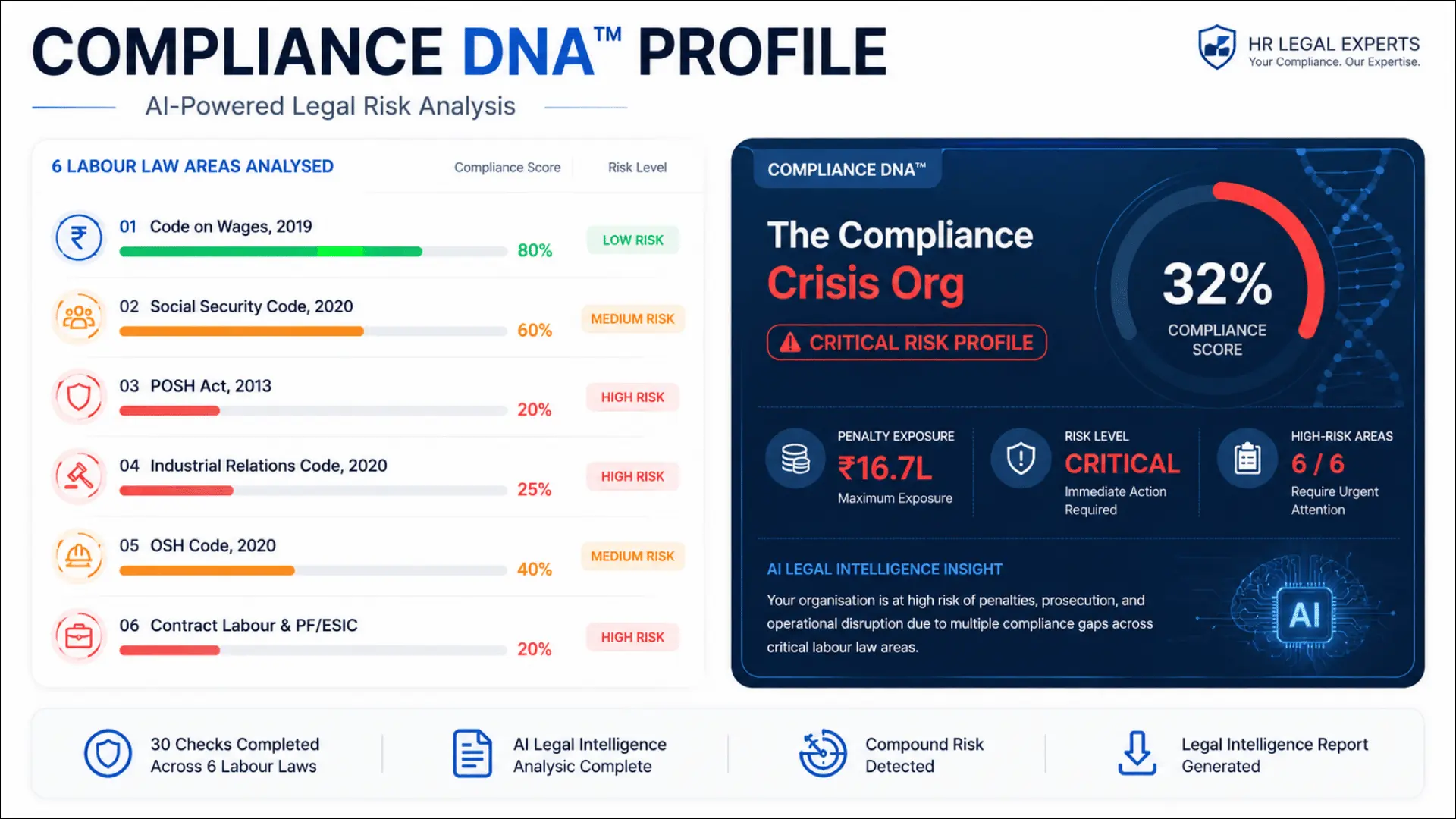
Your results appear in three formats.
Compliance score per section A percentage showing how many checks in each area you passed. A score of 0% in any section means critical violations are currently active.
Penalty Exposure Meter A live rupee total calculated from the specific penalty provisions of the relevant law, not a generalised estimate. It reduces in real time as you confirm compliant items.
Compliance DNA™ profile A label classifying your company’s overall risk level. At maximum exposure, the profile reads “The Compliance Crisis Org,” with a written description of what a single labour department inspection could trigger across your current gaps.
The compound risk analysis identifies when two or more gaps interact to create elevated legal exposure. An unregistered business under the Shops & Establishments Act combined with PF contribution errors, for example, creates simultaneous liability under the Social Security Code, 2020 and state registration law. Inspectors pursue these combinations together, not as separate items.
Key fact: Under the Contract Labour (Regulation and Abolition) Act, 1970, every principal employer with 20 or more contract workers must obtain registration under Section 7. Non-compliance carries a penalty of ₹1 lakh and exposes the company to prosecution under the Act.
After your audit: next actions
The audit tells you what is wrong. Closing the gaps requires a clear priority order, and not every gap can be closed without professional input.
Priority 1: High-penalty, accessible gaps
Outdated wage registers, missing standardised offer letters, and undocumented grievance processes can often be addressed in days with the right templates. Top HR policies covering these areas give you a legally grounded starting point.
Priority 2: Gaps that require legal input
POSH compliance documentation, PF and ESIC registration corrections, contract labour registrations, and termination process formalisation carry the highest individual penalties and attract the most inspection scrutiny. These require professional review before implementation, because an incorrectly drafted policy can be used against you in a dispute, not for you.
Key fact: Under the OSH & Working Conditions Code, 2020, all establishments must issue formal appointment letters to every employee. Non-compliance carries a penalty of ₹20,000 per instance, and the absence of appointment letters significantly weakens an employer’s position in any employment dispute.
Section reference table
Use as an embedded table, standalone graphic, or reference card on the page.
|
Section |
Governing law |
Checks |
Max penalty |
|
Code on Wages |
Code on Wages, 2019 |
5 |
₹2.7L |
|
Social Security |
Social Security Code, 2020 |
5 |
₹3.25L |
|
OSH & Working Conditions |
OSH Code, 2020 |
5 |
₹2.5L |
|
Industrial Relations |
IR Code, 2020 |
4 |
₹2.5L |
|
POSH |
POSH Act, 2013 |
5 |
₹2.25L |
|
Contract Labour & PF/ESIC |
Contract Labour Act, 1970 |
5 |
₹3.5L |
|
Total |
|
30 |
₹16.7L |
Most Indian startups are carrying more than ₹10 lakh in active penalty exposure right now. Your specific number depends on your company, your practices, and your documentation. Run the audit and see exactly where you stand.

FAQs: Frequently Asked Questions
A free HR policy audit is a structured diagnostic that tests your company's HR practices against applicable Indian labour laws. The audit at hrlegalexperts.com covers 30 checks across the Code on Wages 2019, Social Security Code 2020, OSH Code 2020, Industrial Relations Code 2020, POSH Act 2013, and Contract Labour (Regulation and Abolition) Act 1970, and generates a live Penalty Exposure Meter showing your total financial risk in under 4 minutes.
The audit takes under 4 minutes for most companies. You complete 30 checks across six sections, and an AI Legal Intelligence Report generates automatically at the end. No prior HR knowledge or legal background is required to complete it.
Every company with one or more employees carries obligations under at least three of the six laws the audit covers. Under the Code on Wages, 2019, all establishments must maintain wage records and pay minimum wages from day one. Under the POSH Act, 2013, any company with 10 or more employees must have a formal ICC constituted in writing. The audit is most urgent for 0 to 50 employee companies that have never completed a formal compliance review.
A Compliance DNA™ profile is an AI-generated classification of your company's overall compliance risk, produced at the end of the audit. It draws on your responses across all six sections, identifies compound legal risks where multiple gaps interact, and assigns a risk label ranging from compliant to critical. At maximum exposure, the label reads "The Compliance Crisis Org," with a written description of what a single inspection could trigger.
A checklist identifies what to check. This audit calculates what each gap costs in rupees, detects compound risks where two or more gaps create elevated legal exposure simultaneously, and produces a written AI legal brief specific to your company. The maximum penalty exposure visible across all 30 checks is ₹16.7 lakh, drawn from six specific Indian laws.
The maximum total penalty exposure across all 30 checks is ₹16.7 lakh per inspection cycle. This is the sum of individual penalty provisions across the Code on Wages 2019, Social Security Code 2020, OSH Code 2020, Industrial Relations Code 2020, POSH Act 2013, and Contract Labour (Regulation and Abolition) Act 1970. Individual violations range from ₹20,000 to ₹1 lakh each.
The information you provide is used solely to personalise your AI compliance analysis. It is treated as confidential, is not shared with third parties, and is not used beyond generating your legal brief and enabling your HR Legal Experts consultation if you choose to proceed.

HR Legal Experts is a specialized consulting firm helping businesses stay fully compliant with labour laws and HR policies. With a proven track record of serving 500+ organizations, we deliver customized solutions in POSH compliance, employee handbooks, contracts, and regulatory documentation. Our team combines legal expertise with practical HR insights to ensure risk-free, people-first workplaces.

