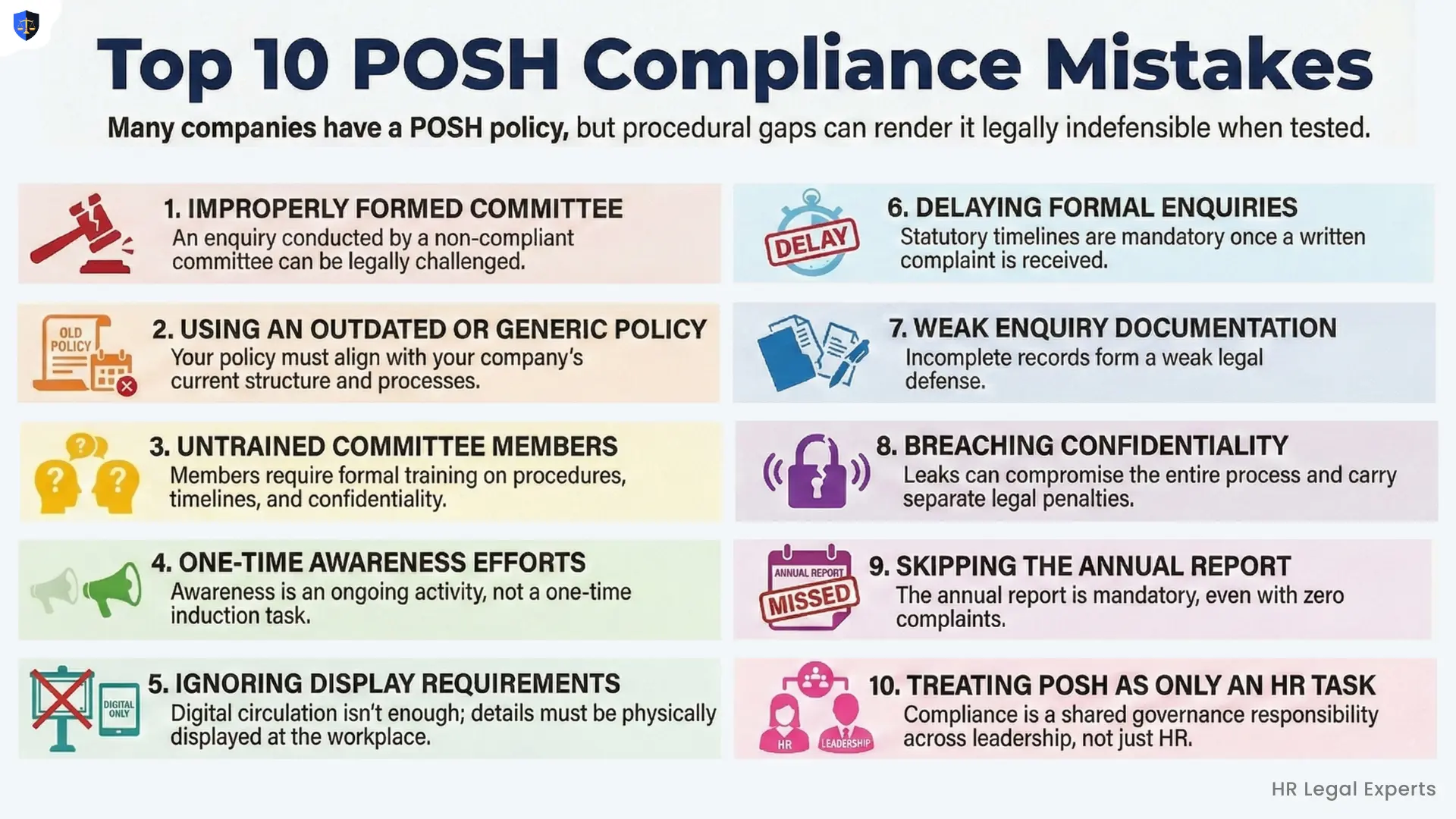
Across industries, POSH compliance breaks down in similar ways. A policy may exist, but the process behind it is unclear. An Internal Committee may be appointed, but its role is not fully understood. These gaps often remain unnoticed until a complaint requires formal action, at which point the organisation realises that key statutory steps were never fully implemented.
POSH is a procedural law. Compliance depends not only on documentation but also on how consistently each requirement is applied in practice. When even one element is incomplete, the framework becomes difficult to defend.
This article examines the most common posh compliance mistakes, explaining where organisations typically go wrong and why these faults create legal exposure if left unaddressed.
1. Incorrect constitution of the Internal Committee
POSH compliance begins with the Internal Committee. The law clearly specifies who can be appointed and in what capacity.
The committee must include a woman presiding officer, qualified internal members, and an external member with relevant experience. In practice, organisations often appoint available senior employees without verifying eligibility or postponing the external member altogether.
This becomes a critical issue when a complaint is received. An enquiry conducted by an improperly constituted committee can be challenged, regardless of how fairly it was handled.
Regular review of Committee composition and eligibility is essential to ensure that the enquiry process remains legally valid.
2. Relying on a generic or outdated POSH policy
Many organisations have a POSH policy on record, but few review whether it reflects how the organisation functions.
Policies are often copied from templates and left unchanged even as teams expand, reporting lines shift, or new locations are added. Over time, the policy and the actual process drift apart.
When a complaint arises, this mismatch becomes visible. Inconsistencies between what the policy states and what the organisation practices weaken the employer’s position.
A compliant POSH policy must be specific, current, and aligned with internal processes.
3. Appointing Internal Committee members without training
Being part of an Internal Committee requires more than seniority or intent. Members are expected to understand enquiry procedures, timelines, documentation standards, and confidentiality obligations.
In many organisations, committee members are appointed but never formally trained. They are expected to manage complaints based on instinct or general HR experience.
This often leads to procedural errors that are avoidable. Training equips members to handle sensitive matters with clarity and consistency, which is critical for compliance.
4. Treating employee awareness as a one-time activity
Awareness is central to POSH compliance, yet it is often treated as a one-off exercise.
Some organisations limit communication to a policy upload or a brief induction mention. Over time, employees are unsure about complaint mechanisms or hesitant to raise concerns.
From a legal perspective, lack of awareness undermines the intent of the Act. Regular sessions help reinforce expectations, responsibilities, and trust in the process.
5. Ignoring mandatory display requirements
The law requires POSH details to be displayed prominently at the workplace. This includes committee information and complaint procedures.
Many organisations rely entirely on digital circulation, assuming that access equals compliance. During audits or inspections, this assumption does not hold.
Visible display serves as evidence that the organisation has actively communicated the process, not merely documenting it.
6. Delaying the initiation of formal enquiries
When a complaint is received, hesitation often follows. Employers may attempt informal resolution or delay proceedings to avoid escalation.
While well intentioned, this approach conflicts with statutory timelines. Delay weakens procedural fairness and exposes the organisation to challenge.
Once a written complaint is received, formal steps must begin promptly and in accordance with the Act.
7. Maintaining weak or inconsistent enquiry documentation
POSH enquiries rely heavily on documentation. Notices, statements, evidence records, minutes, and findings together form the legal record of the process.
In practice, documentation is sometimes incomplete or prepared retrospectively. This creates gaps that become difficult to explain later.
Consistent documentation is not formal. It is the backbone of a defensible inquiry.
8. Breaching confidentiality during the process
Confidentiality is one of the most misunderstood POSH obligations.
Information is often shared beyond the Internal Committee, sometimes unintentionally. Even limited disclosure can compromise the integrity of the process.
The Act requires strict confidentiality at every stage. Failure to maintain it can result in separate legal consequences.
9. Missing the annual POSH reporting requirement
Many organisations are unaware that an annual POSH report must be submitted to the district authority.
This obligation exists regardless of whether complaints were received during the year. Non submission is treated as non-compliance.
Maintaining a reporting calendar and records of submission helps avoid unnecessary penalties.
10. Treating POSH as an HR task rather than a governance function
POSH compliance is often delegated entirely to HR teams. While HR plays a key role, statutory responsibility rests with the employer.
Without leadership oversight and committee independence, the system weakens over time.
Effective compliance requires shared accountability across HR, the Internal Committee, and organisational leadership.

Conclusion
Most POSH compliance mistakes are not the result of neglect but partial implementation. POSH compliance works when structure, documentation, and awareness operate together. Organisations that invest in clarity and preparedness reduce risk, build trust, and strengthen workplace governance.
Addressing these gaps early is significantly easier than defending them after a complaint arises.
POSH compliance works best when it is reviewed before it is tested.
HR Legal Experts helps organisations assess, strengthen, and sustain legally defensible POSH systems.
Contact HR Legal Experts for POSH compliance support.

HR Legal Experts is a specialized consulting firm helping businesses stay fully compliant with labour laws and HR policies. With a proven track record of serving 500+ organizations, we deliver customized solutions in POSH compliance, employee handbooks, contracts, and regulatory documentation. Our team combines legal expertise with practical HR insights to ensure risk-free, people-first workplaces.
