
HR Checklist of a legal employment agreement in India
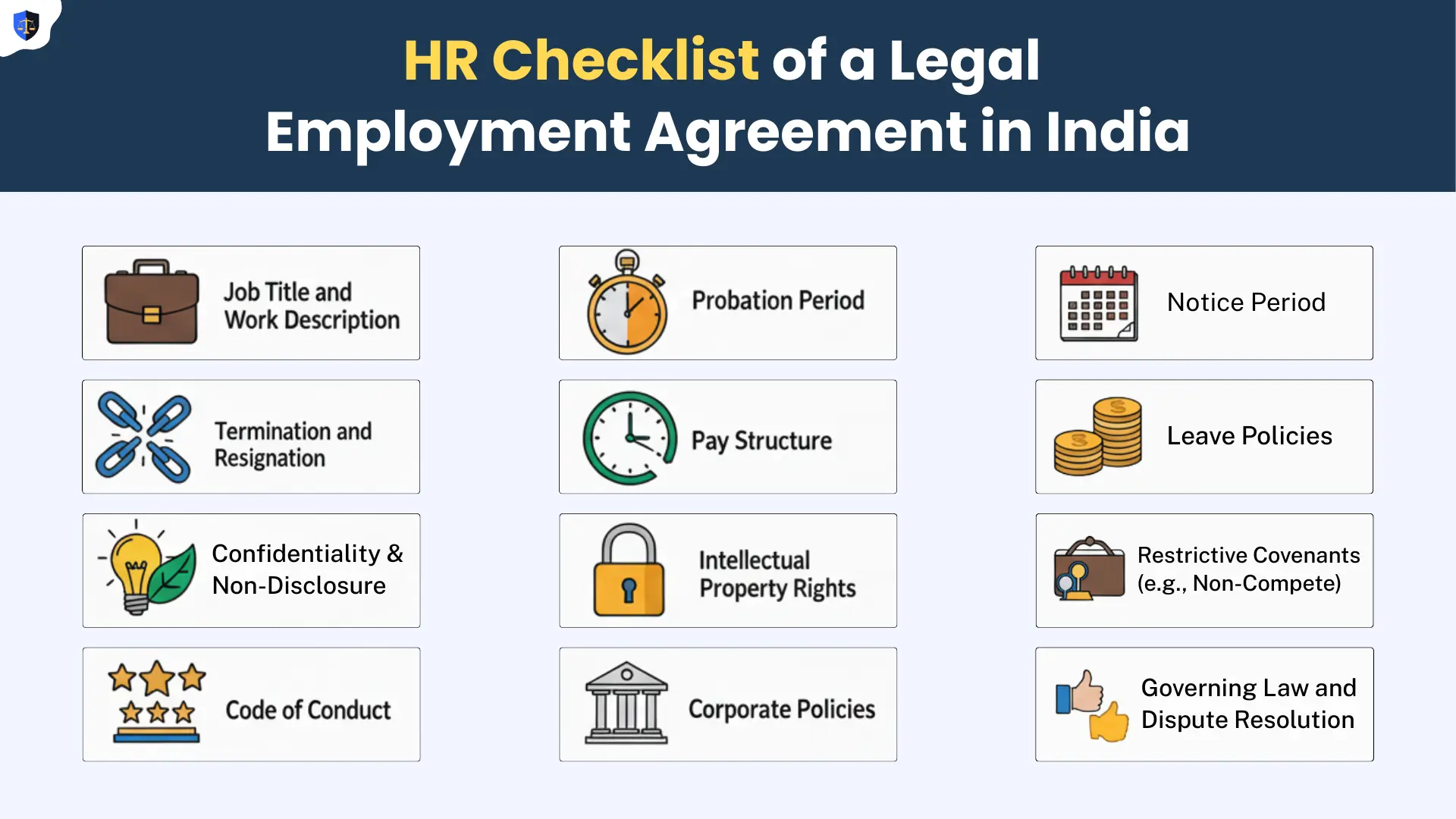
A comprehensive employment agreement in India should cover the following components to ensure clarity, fairness, and legal compliance:
Job Title and Work Description
• Specify whether the job is full-time, part-time, probationary, or contractual.
• This ensures both the employer and employee are on the same page about expectations.
Probation Period
• Probation is crucial for evaluating performance and cultural fit.
• In India, probation periods usually range 3–6 months.
• During probation, notice periods may be shorter, but still must comply with rules of natural justice and state labour regulations.
• From our perspective, a well-defined probation clause avoids misunderstandings and protects both parties.
Notice Period, Termination, and Resignation
• Specify reasons for termination, notice periods, and conditions during probation.
• For permanent employees, follow the Industrial Disputes Act regarding notice and severance pay if applicable.
• Clear wording prevents disputes and reduces legal and reputational risks.
Pay Structure
• Include base salary, bonuses, allowances, and deductions such as PF, ESI, and TDS.
• Courts have emphasized transparency in salary components to prevent misclassification or underpayment.
• Link pay provisions to legal requirements like the Minimum Wages Act to ensure compliance and reduce litigation risk.
Working Hours and Time-Off Policies
• Define maximum working hours, rest days, paid leave, and overtime rules.
• Adhere to the Shops and Establishments Act of the respective state.
• Clear policies help set realistic expectations and foster trust with employees.
Confidentiality, Non-Compete, and Intellectual Property Clauses
• Include non-disclosure clauses to protect confidential information.
• Non-compete clauses post-termination must be reasonable in scope and duration (Section 27 of the Indian Contract Act).
• Clarify ownership of intellectual property created during employment.
• Our advice: well-drafted clauses protect the organization while maintaining employee trust.
Governing Law and Dispute Resolution
• Include jurisdiction clauses specifying whether disputes go to civil courts or arbitration.
• Critical for companies operating across states or with foreign ownership.
• Clear dispute resolution reduces conflicts and provides certainty.
Performance Reviews, Code of Conduct, and Corporate Policies
• Reference internal documents such as POSH policies, leave manuals, and disciplinary procedures.
• Ensures enforceability of rules and sets clear expectations for employee behavior.
• From our experience, tying agreements to internal policies makes them practical, not just legal formalities.
Steps to make your employment agreement legally binding in India
While the Key Components explain what to include, these steps focus on how to make your employment agreement enforceable and effective:
1. Identify the role and responsibilities clearly
• Understand the job, type of employment, and expected outcomes.
• This forms the foundation of a legally sound contract.
2. Draft role-specific clauses
• Include probation, notice periods, termination, confidentiality, IP, and dispute resolution.
• Avoid generic templates; tailor clauses to your organization’s needs.
3. Ensure compliance with Indian labour laws
• Check applicable acts like the Indian Contract Act, Industrial Disputes Act, Shops & Establishments Act, and Minimum Wages Act.
• Adapt clauses to your state-specific regulations.
4. Use clear, unambiguous language
• Avoid overly legalistic jargon; clarity prevents disputes.
• Make terms fair for both employer and employee.
5. Reference internal policies for enforceability
• Link agreements to your POSH policy, leave manuals, or code of conduct.
• Ensures corporate rules are legally recognized.
6. Review with HR and legal experts
• Validate that all clauses are compliant, enforceable, and risk-free.
• Correct errors before employee signatures.
7. Obtain proper documentation
• Both employer and employee must sign the agreement.
• Keep records securely to protect against future disputes.
How HR Legal Experts help you solve real problems

A legal employment agreement in India is only useful if it solves real HR problems. At HR Legal Experts, we focus on making agreements practical, not just compliant:
• Reduce HR risks: Avoid disputes over probation, notice periods, or termination.
• Ensure compliance: Keep your contracts up-to-date with labour laws across states.
• Protect confidential info: Draft enforceable confidentiality, non-compete, and IP clauses.
• Save time and effort: We create role-specific agreements so your HR team can focus on growth.
• Practical guidance: We don’t just write contracts; we explain them so managers and employees understand expectations.
Think of us as your problem-solving partner, turning complex legal requirements into simple, actionable, and enforceable agreements.

HR Legal Experts is a specialized consulting firm helping businesses stay fully compliant with labour laws and HR policies. With a proven track record of serving 500+ organizations, we deliver customized solutions in POSH compliance, employee handbooks, contracts, and regulatory documentation. Our team combines legal expertise with practical HR insights to ensure risk-free, people-first workplaces.