Hybrid Attendance Disputes in India

HR Legal Experts

Hybrid attendance disputes are no longer theoretical. Across India, companies are receiving employee grievances, legal notices, and labour inspection queries linked directly to unclear hybrid attendance practices.

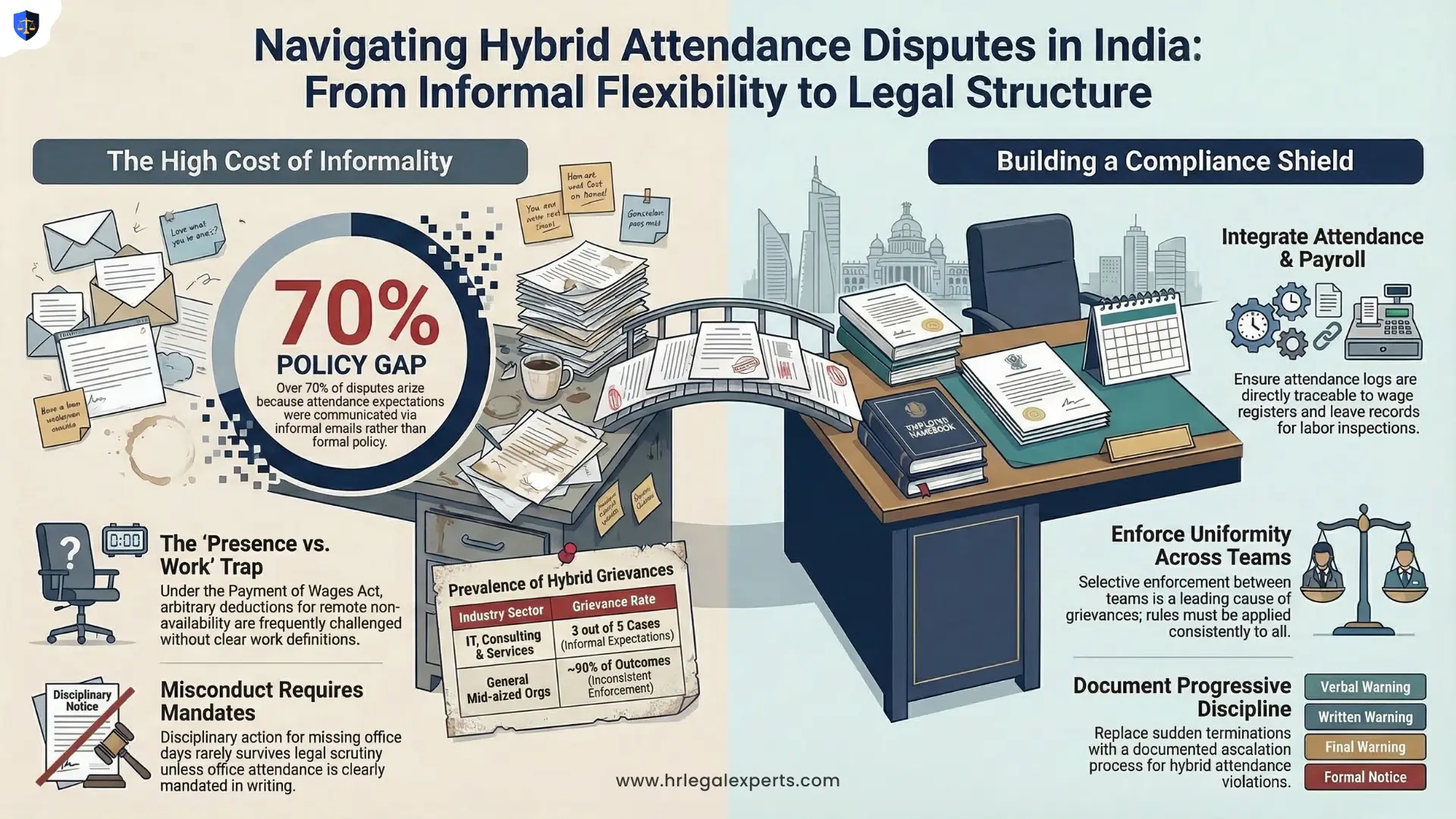
In recent internal compliance reviews across IT, consulting, and services sectors, attendance-related issues featured in nearly 3 out of 5 employee grievances where hybrid work was involved. The dispute rarely arises because hybrid work itself is unlawful. It arises because attendance expectations were informal, inconsistently enforced, or undocumented.

When conflicts escalate, employers often discover that flexibility without legal structure weakens their position.

This article examines real patterns behind hybrid attendance disputes in India, the legal issues involved, and what employers must do to protect themselves.

What triggers hybrid attendance disputes

Hybrid attendance disputes usually begin when expectations differ.

Common triggers include:

• salary deductions for alleged remote non-availability

• warnings issued for missing office days without written rules

• termination based on “attendance issues” without policy backing

• disputes over whether login time equals attendance

In grievance proceedings and legal notices, the first document demanded is the attendance policy. In more than 70 percent of hybrid attendance disputes reviewed internally, employers struggled because expectations were communicated informally through emails or verbal instructions rather than policy.

If the policy is silent or vague, employer decisions become difficult to defend.

Top 5 hybrid attendance disputes
Hybrid Attendance Disputes in India Policy

Legal issue #1: Attendance vs wages

Under Indian employment law, wages are payable for work performed. In hybrid models, disputes arise when employers equate physical presence with work.

Authorities examine:

• whether work was assigned and completed

• whether working hours were defined

• whether attendance rules were documented

Under the Payment of Wages Act, 1936, salary deductions must be justified and supported by records. In hybrid attendance disputes, deductions made without policy-backed absence classification are frequently challenged as arbitrary.

Legal insight:

Attendance tracking must be linked to defined working hours or deliverables, not assumptions of presence.

Legal issue #2: Office attendance as misconduct

Many disputes arise when employees are disciplined or terminated for not attending the office on specific days.

Legally, absence becomes misconduct only when:

• office attendance is clearly mandated in policy or contract

• consequences of non-compliance are defined

• the employee was informed in advance

In multiple dispute cases reviewed, employers failed to sustain disciplinary action because office attendance requirements were conveyed through internal emails after hiring, not through a documented hybrid attendance policy.

Legal insight:

Without a written hybrid attendance policy, office non-attendance rarely survives scrutiny as misconduct.

Legal issue #3: Inconsistent enforcement across teams 

Hybrid attendance disputes frequently involve allegations of unequal treatment.

Employees argue that:

• certain teams were allowed full remote work

• others were penalised for similar behaviour

• attendance rules changed without notice

Indian courts consistently examine consistency and fairness. Even a valid attendance rule weakens if it is applied selectively.

In internal grievance outcomes, inconsistent enforcement was cited in nearly half of hybrid attendance disputes reviewed across mid-sized organisations.

Legal insight:

Attendance rules must be applied uniformly or clearly differentiated by role in writing.

Legal issue #4: Termination linked to attendance 

Termination disputes linked to hybrid attendance often fail because employers cannot demonstrate proportionality.

Authorities review:

• whether warnings were issued

• whether the employee was given time to comply

• whether attendance violations were recorded

Immediate termination without progressive discipline is frequently challenged as unfair under principles of natural justice applied by labour authorities.

Legal insight:

Hybrid attendance violations should follow a documented escalation process, not sudden termination.

Legal issue #5: Absence, leave, and hybrid overlap 

A recurring issue is confusion between absence, leave, and hybrid schedules.

Disputes arise when: 

• employees treat remote days as informal flexibility

• employers treat non-availability as unauthorised absence

• leave policies do not integrate with hybrid attendance rules

Under the Shops and Establishments Acts applicable across states, absence procedures must be clear and consistently followed. Hybrid models that bypass leave integration often escalate into disputes over wage deduction or abandonment of service.

Legal insight:

Hybrid attendance policies must clearly integrate leave and absence procedures.

Why hybrid attendance disputes are increasing

Hybrid work blurred traditional attendance concepts. Compliance scrutiny has sharpened them.

Labour authorities now expect:

• written attendance definitions

• traceable attendance and work records

• alignment between attendance logs and payroll 

In recent inspections, attendance documentation was reviewed alongside wage registers and leave records, particularly where hybrid work was in place.

Disputes arise not because hybrid work is risky, but because policies lag behind practice.

How employers can prevent attendance disputes

From a legal standpoint, prevention depends on documentation and consistency.

Employers should ensure:

• a clearly drafted hybrid attendance policy

• defined office attendance rules

• attendance tracking aligned with payroll

• disciplinary linkage documented

• uniform enforcement

A legally structured policy reduces disputes before they arise.

👉 Use a legally aligned hybrid attendance policy template

Conclusion

Hybrid attendance disputes expose a simple reality. Flexibility without legal clarity creates conflict.

Indian employers who treat attendance policies as operational notes rather than legal documents face avoidable disputes. Those who document expectations, communicate them clearly, and enforce them consistently are far better protected.

A compliant hybrid attendance policy is not restrictive. It is preventive.

Frequently Asked Questions

1) Are hybrid attendance disputes legally valid in India?

Yes. Disputes arise when salary, discipline, or termination is linked to attendance without policy clarity.

2) Can employees refuse office attendance in hybrid roles?

Only if office attendance is not clearly mandated in policy or contract.

3) Can salary be withheld for remote attendance issues?

Only when absence is documented and policy-backed.

4) Do labour inspectors review hybrid attendance records?

Yes. Attendance and payroll records are often examined together.

5) Is a hybrid attendance policy mandatory by law?

Not expressly, but absence of one weakens the employer’s legal position.