5 Hidden Leave Policy Mistakes Costing Companies Lakhs in 2026

HR Legal Experts

Why Your Leave Policy May Already Be Non-Compliant

If your leave policy has not been reviewed recently, there is a strong chance it no longer aligns with current leave policy compliance expectations in India. Most issues flagged during inspections are not deliberate violations. They are the result of outdated templates, unclear clauses, or assumptions carried forward from older labour frameworks.

Leave policies are now one of the first documents reviewed during labour audits and leave policy audits. Errors around entitlement, accrual, leave encashment rules, and worker coverage are easy to detect and difficult to justify once flagged.

This article focuses on five specific leave policy mistakes that are already costing companies money in 2026 and explains what HR teams should fix immediately.

5 Leave Policy Mistakes You Must Fix in 2026

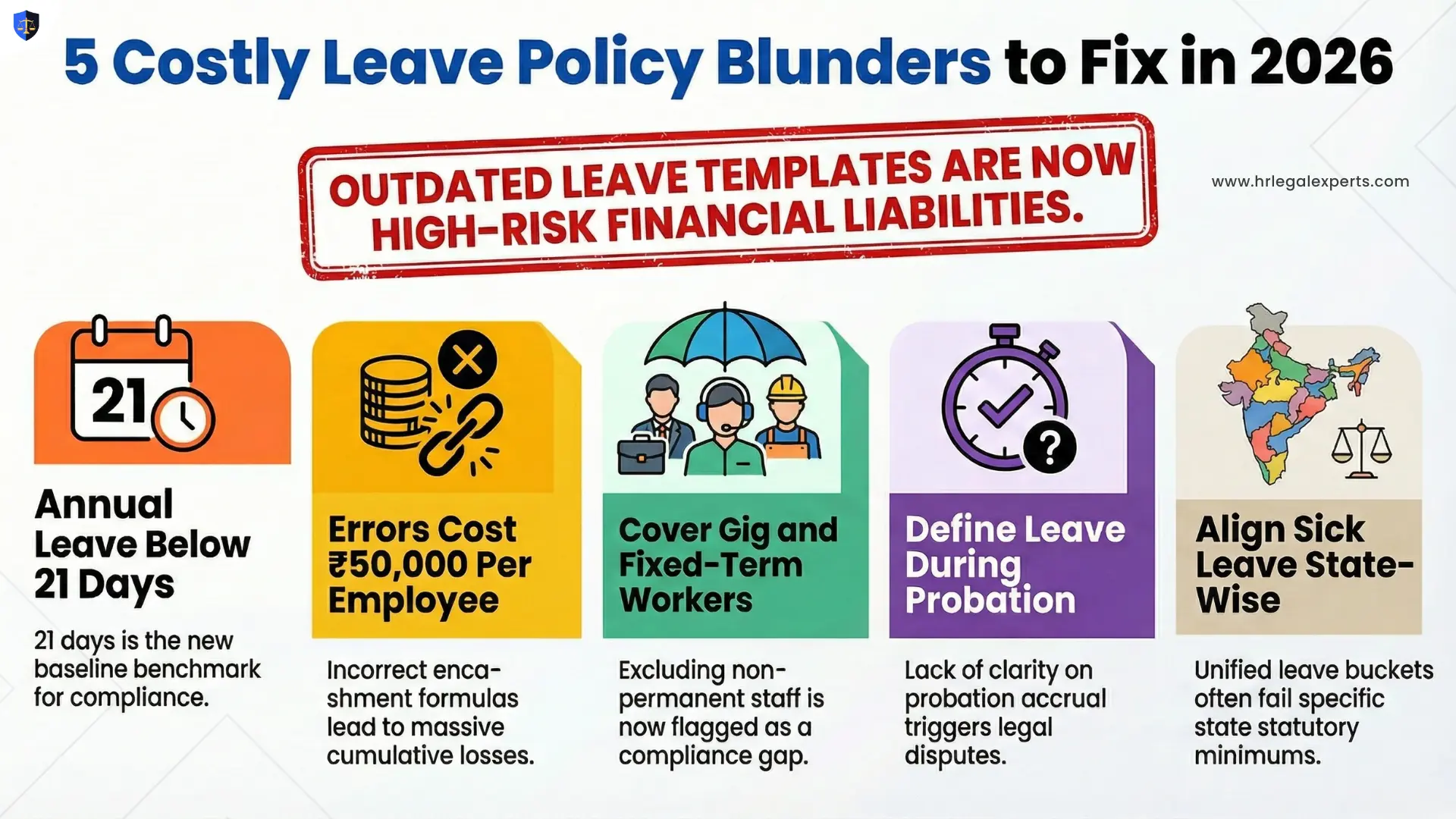
1. Annual Leave Below 21 Days

If your policy still provides 15 or 18 days of earned leave, it is misaligned with current leave entitlement rules in India. 

In practice, 21 days of annual leave has become the baseline benchmark for most establishments under the 2026 framework. Policies offering less without statutory justification are increasingly treated as leave policy non-compliance during inspections. 

What to review: 

• total annual leave entitlement

• accrual method and frequency

• applicability across employee categories

Lower entitlements are now treated as a compliance gap rather than a business decision.

2. Unclear Sick and Casual Leave Rules

Many organisations merged sick and casual leave without clearly defining how the combined entitlement works.

This becomes an issue because sick leave rules in India continue to vary by state. A unified bucket that does not specify entitlement, usage, or limits often results in employees receiving less than the statutory minimum under state-wise leave rules.

Check whether your policy clearly states:

• total days available under the combined leave

• state-wise applicability, where relevant

• usage and carry-forward rules

If this section is vague, it increases the risk of leave policy compliance issues.

Fix this using a compliant template

3. Probation Leave Not Defined

Probation is one of the most common sources of leave-related disputes. 

Many policies do not clarify probation leave rules, including whether leave accrues during probation, whether it can be availed, or what happens to accrued leave upon confirmation. In audits, this silence often results in employees losing entitled leave unintentionally. 

Your policy should explicitly mention: 

• leave accrual during probation

• usage restrictions, if any

• carry-forward or lapse on confirmation

Clear probation clauses reduce disputes and strengthen HR policy compliance.

5 Costly Leave Policy Blunders to fix in 2026 - hrlegalexperts

4. No Coverage for Gig or Fixed-Term Workers

If your leave policy applies only to permanent employees, it is incomplete. 

Under evolving labour compliance standards, fixed-term employee leave and gig worker leave policy coverage are increasingly reviewed. Policies that do not mention these worker categories are treated as non-consideration rather than exclusion.

Review whether your policy:

• identifies covered worker categories

• specifies entitlement or justified exclusion

• aligns with contractual arrangements

This gap is now actively noticed during inspections.

5. Incorrect Leave Encashment Calculation

Leave encashment errors are costly and often detected late.

Common issues include:

• incorrect wage component used for leave encashment calculation

• wrong carry-forward caps

• outdated encashment formulas

In several internal reviews, companies lost more than ₹50,000 per employee due to cumulative leave encashment rule miscalculations.

Encashment rules must clearly align with:

• wage definitions under applicable law

• accrual limits

• final settlement process

This is a leave policy design issue, not just a payroll issue.

Must Read: Leave rules under the new labour codes

Key Takeaway for HR Teams

Leave policy mistakes rarely appear urgent until they accumulate. By the time leave policy audits begin, corrections often come with financial impact and back-pay exposure.

Reviewing and updating your leave policy now is one of the simplest ways to stay compliant and avoid unnecessary exposure in 2026.

Avoid penalties before they arise.

Download the complete checklist and ready-to-use template.

Frequently Asked Questions

1. What happens if a leave policy is non-compliant in India?

A non-compliant leave policy can lead to audit observations, back-dated leave corrections, penalties, and employee claims.

2. Do labour inspectors check leave policies during audits?

Yes. Leave policies are often reviewed early because entitlement and encashment data is easy to verify.

3. Can companies offer more than 21 days of annual leave?

Yes. Employers may offer more than the statutory benchmark, but offering less without justification increases compliance risk.

4. Is leave encashment mandatory at the time of exit?

Leave encashment is payable if provided under the company’s leave policy or applicable labour law.

5. Can leave rules differ for different states in India?

Yes. Sick and casual leave requirements vary by state, and policies should account for this difference.

6. Do startups and MSMEs need the same leave policy compliance?

Yes. Company size does not exempt employers from leave policy compliance under labour laws.

7. When should a leave policy be updated?

A leave policy should be updated whenever labour laws change and reviewed at least once every year.